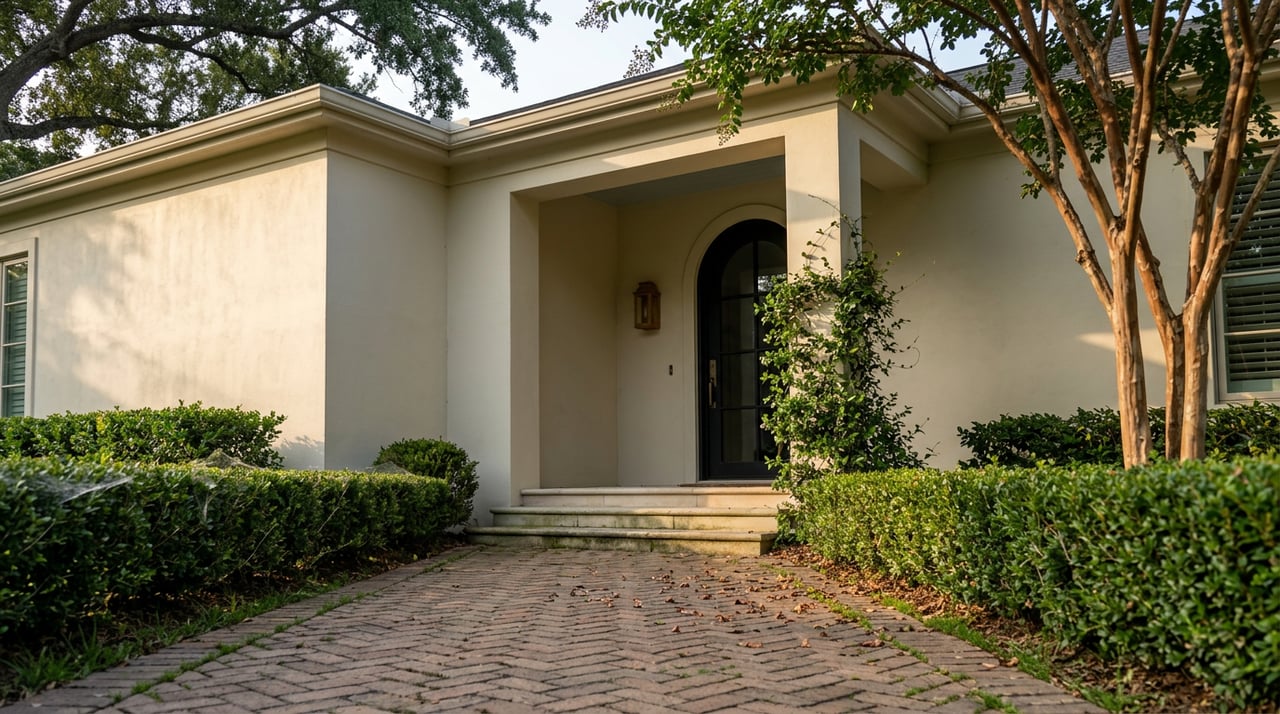
Sugar Creek Country Club Membership Costs: What HOA Fees Don't Cover
September 17, 2026
September 17, 2026
Picture the moment a buyer signs off on a home in Sugar Creek. The listing mentioned a country club community, the HOA disclosure named a modest annual fee, and the assumption that formed somewhere between the first showing and the closing table was simple: the fee covers the club. Golf, tennis, the pool, the dining room. But the HOA fee covers neighborhood services, not access to the club.
A buyer who wants access to Sugar Creek Country Club needs to apply for membership separately; a home purchase does not include club membership.
The key distinction is between two organizations that share a name, a set of gates, and fifty years of shared history, but not a bank account. Understanding where one ends and the other begins is the single most useful thing a buyer in this neighborhood can know before making an offer.
Sugar Creek Country Club has operated since 1972 as a private, member-owned club, the kind of institution where members have called it a second home for decades. That history is real, and it shapes how the neighborhood is marketed and how it feels to walk the grounds. But a private, member-owned club is a legal entity distinct from the homeowners association that governs the surrounding streets. One collects dues to run a golf course and a dining room. The other collects assessments to maintain common areas and enforce deed restrictions. They share a ZIP code. They do not share a ledger.
The club's own materials are direct about this: membership is by application and subject to approval. That phrase is doing more work than it first appears to. It means a change of deed does not carry a membership with it. A new owner does not inherit a parent's club standing any more than they inherit a parent's country club standing in Houston or Dallas. They apply, independently, and the club decides.
The clearest way to see the split is to lay the two obligations side by side.
| Neighborhood HOA | Sugar Creek Country Club | |
|---|---|---|
| What it covers | Common area upkeep, one small neighborhood pool, deed restriction enforcement | Golf course, tennis, main clubhouse, dining, second pool |
| Who runs it | A homeowners association board (Sugar Creek has more than one, depending on section) | A private member-owned club with its own board |
| How you join | Automatic with home purchase | Separate application, subject to approval |
| What determines cost | Lot type and street | Membership category chosen |
The HOA fee for a typical Sugar Creek home runs roughly $500 to $1,500 a year, and the variance inside that range is not random. Homes along Country Club Boulevard carry built-in front yard maintenance as part of their HOA service, which is what pushes those particular fees toward the top of the band. Everywhere else in the neighborhood, the fee is closer to basic upkeep: streetlights, common areas, one small community pool that has nothing to do with the club's larger facilities.
Club dues are a different conversation entirely, set and adjusted by the club itself rather than by the neighborhood's governing documents. Anyone seriously evaluating a purchase here should treat the current initiation and dues schedule as a question for the club directly, not an assumption to carry in from a listing sheet. Numbers move, membership categories change, and the only reliable source is the club's own membership page.
Sugar Creek is not governed by a single homeowners association the way many newer master-planned sections of Fort Bend County are. Multiple associations operate within the neighborhood depending on section and street, each with its own board and its own fee schedule. That structure explains why two buyers comparing notes on Sugar Creek HOA costs can end up describing what sound like two different neighborhoods. They are, in a narrow but meaningful sense, in two different associations.
For a buyer, this means the HOA disclosure attached to a specific listing is not a stand-in for "what Sugar Creek costs." It is what that particular address costs, under that particular association's rules. In Texas, management certificates for homeowners associations are public record filed with the Texas Real Estate Commission and searchable through the state's HOA registry, which is the fastest way to confirm which association actually governs a given street before assuming anything from a neighborhood-wide reputation.
Money alone does not resolve the club side of the equation. Membership is structured around approval, not purchase, and the club's own terms describe a family unit, primary member, spouse, and dependent children up to age twenty five, rather than a per-person transaction. That family framing matters for buyers weighing whether a membership makes financial sense relative to how many people in the household will actually use it.
It also means the timeline for closing on a home and the timeline for being approved into the club are not the same clock. A buyer who wants club access from day one should start that application well before the home sale closes, not after moving trucks have already come and gone.
None of this is a reason to avoid Sugar Creek. It is a reason to ask two separate questions instead of one. First, what does this specific address's HOA cover, and which association actually administers it. Second, is the current owner a club member, and if the answer matters to the buyer's plans, has an inquiry already gone to the club about the application process and current approval timeline.
A private-client approach to this neighborhood means treating those as two distinct pieces of due diligence rather than one line item to skim past on a disclosure form. The HOA fee tells a buyer what the deed obligates them to. It tells them nothing about whether they will ever set foot in the clubhouse.
Does every home in Sugar Creek require country club membership? No. Club membership is optional and separate from the HOA. A homeowner can live in Sugar Creek without ever applying to the club, though they will not have access to its golf course, tennis facilities, or main clubhouse without it.
If I buy a home from a current club member, do I inherit their membership? No. Membership is tied to the individual application and approval, not to the property. A new owner applies independently regardless of the seller's status.
Why do HOA fees vary so much between homes in the same neighborhood? Sugar Creek has more than one homeowners association covering different sections, and fee structures differ by street and lot type, most visibly on Country Club Boulevard, where built-in lawn maintenance raises the fee relative to the rest of the neighborhood.
If you are weighing a purchase in Sugar Creek and want the actual fee structure, association, and club timeline sorted out before you write an offer, Fort Bend Real Estate Corporation has spent decades untangling exactly this kind of local detail for buyers who would rather know the full cost picture at the offer stage than discover it at closing. Schedule a consultation and we will walk the specific address, the specific association, and the specific club timeline with you before you commit to either.
This article is general information, not legal, tax or financial advice. Consult a qualified professional about your situation.



Tell us about your real estate goals, and we'll help you navigate the process with confidence and ease.

Fort Bend Real Estate Corporation
8410 HIGHWAY 90A STE 120 SUGAR LAND TX 77478