In Venetian Estates, the HOA Fixes the Rules. It Doesn't Fix Your Bulkhead.
September 17, 2026
September 17, 2026
Buyers touring a lakefront listing in Venetian Estates tend to ask the right questions about the house and the wrong question about the water. They ask about square footage, about the primary suite, about whether the kitchen has been updated. They rarely ask who is responsible for the concrete or steel wall holding the lake back from the yard. That is the question worth asking first, because the mandatory homeowners association that governs this neighborhood was never built to answer it.
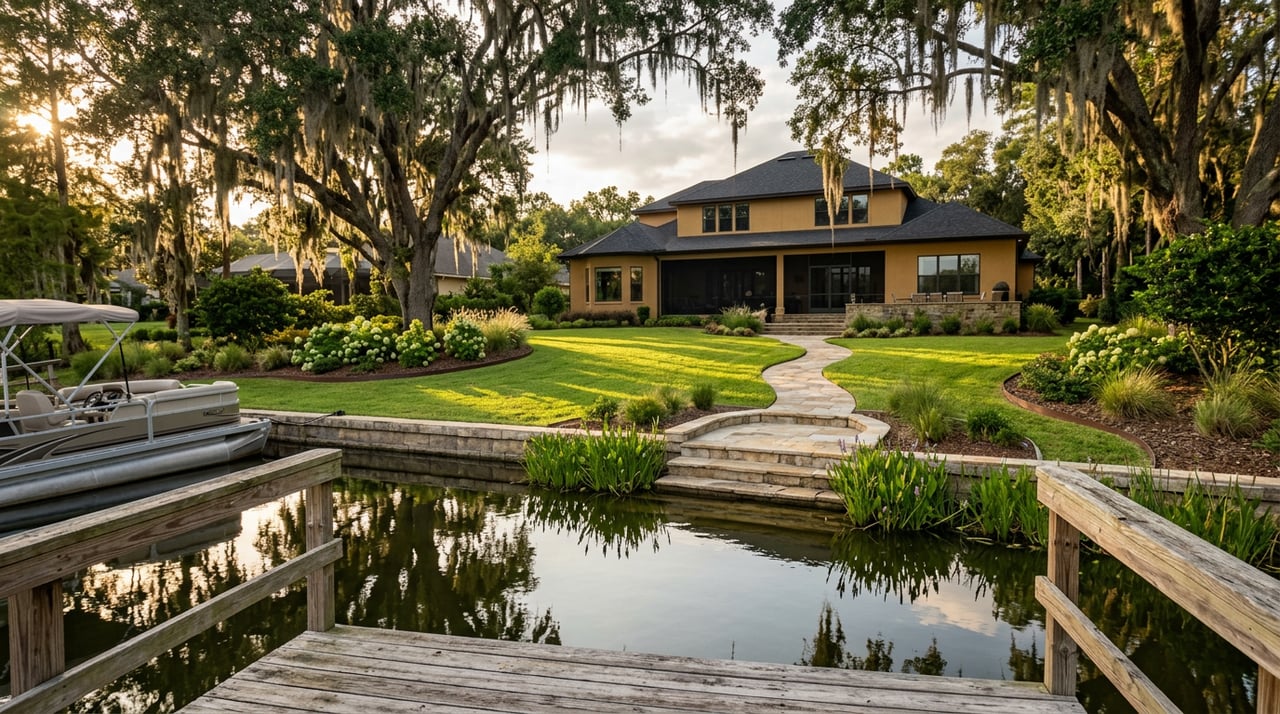
Venetian Estates is one of Sugar Land's original luxury communities, developed around a series of dredged canals and lakes beginning in the late 1950s. The centerpiece is the roughly 44-acre Lake Venice, joined by two smaller lakes, Lake Elda and Lake Angela. Homes sit on generous lots, many exceeding half an acre, with private docks reaching into water that residents fish, kayak, and pontoon across on any given weekend. That water is the neighborhood's defining asset. It is also the one piece of the property that the HOA dues do not cover.
Membership in the association, formally the Lake Venice Property Owners Association, doing business as the Venetian Estates Property Owners Association, is mandatory for every homeowner in the neighborhood. The association contracts with a management firm, MASC Austin Properties, to handle the daily administrative work: tracking deed restriction compliance, mailing violation notices, and fielding resident complaints about issues like noise or lighting.
The enforcement process is procedural and specific. A homeowner out of compliance receives a notice after a first inspection, then a second, then a third, with the board or committee able to escalate matters if violations persist. Owners who are not living on-site have violation notices mailed to both their listed address and the property itself. Residents with questions about a notice are directed to named staff at the management company, Gloria Rodriguez for deed restriction matters and Leticia Gomez as property manager.
That is a genuinely useful system. It protects the visual consistency that makes the neighborhood desirable in the first place, and it gives homeowners a documented process rather than an informal one. What it does not do is fund or coordinate repair of the private waterfront infrastructure attached to any single lot. The bulkhead, the dock, the retaining wall between a backyard and the lake, all of that sits with the individual owner.
The clearest illustration of this split comes from the neighborhood's own newsletter archive, not from a policy document. For years, a vacant waterfront lot at 311 Savoy sat undeveloped and became an informal convenience for the block. Residents and lake management used it as a launching point for boats, dropping vessels into Lake Venice and pulling them back out, an arrangement that worked because no one owned it in a way that mattered day to day.
That changed once the lot sold and construction began. The new owners initially allowed neighbors to keep using the site for quick boat launches, but only on a temporary basis and only with advance notice. The newsletter was direct about the cutoff: once bulkhead repair, replacement, or home construction started on that lot, the informal arrangement would end. The water access that had functioned like a shared amenity for years was, legally and practically, always private property waiting for its owner to build.
That is the mechanism worth understanding before you make an offer on any lakefront home here. The lake itself has a communal feel. The bulkhead holding your specific yard in place does not. It is a private capital project that belongs to whoever owns the lot, the same way a roof or a foundation does, except it sits below the waterline where a buyer cannot always see its condition during a normal walkthrough.
This split is not unique to Venetian Estates, and it is not something the association invented to avoid cost. Texas law gives homeowners associations broad authority to collect assessments and enforce deed restrictions, but no state agency regulates HOAs directly or dictates what falls inside versus outside their maintenance scope. That determination comes from the association's own governing documents, the declaration and bylaws filed with the county, not from a statewide standard that applies the same way to every lake community.
The Texas Residential Property Owners Protection Act, found in Chapter 209 of the Property Code, sets rules around board governance, notice requirements, and a homeowner's right to access association records. It does not specify who pays to rebuild a private seawall. Whether that responsibility belongs to the HOA, the individual owner, or some shared arrangement is answered entirely by what a particular community's documents say, which is exactly why the answer differs from one lake neighborhood to the next and why a buyer cannot assume the same rule applies in Venetian Estates as in a comparable community elsewhere in Houston.
Here is the practical breakdown for what mandatory dues in Venetian Estates are understood to fund, based on the association's own published enforcement and management structure, against what stays with the individual lot:
| Typically Covered by HOA Structure | Typically the Homeowner's Responsibility |
|---|---|
| Deed restriction enforcement and violation notices | Bulkhead and seawall repair or replacement |
| Management company administration (MASC Austin Properties) | Private dock construction and upkeep |
| Community-wide communication and events | Boat lift maintenance |
| Architectural review of visible exterior changes | Erosion or settling along the individual waterline |
For a buyer already comparing specific Venetian Estates listings, the bulkhead question deserves the same seriousness as a foundation inspection, because in practice it functions the same way. A few things worth confirming before you get to the option period:
Ask the seller directly when the bulkhead was last repaired or replaced, and in what material. Concrete, steel, and vinyl bulkheads age differently, and a wall installed decades ago carries different risk than one built alongside a recent custom home.
Ask whether any lake-adjacent special assessments have come up in board minutes, even if they were not charged to this specific lot. An assessment tied to shared lake water quality or dredging is a different animal from a private bulkhead job, and knowing which one a seller is describing matters.
Request the association's governing documents directly from the current owner or through the management company rather than relying on a listing description. The declaration will state, in writing, where the line falls between common property and private lot for that specific address, since not every lot touches the water the same way.
If you are the seller, treat the bulkhead the way you would treat an older roof. Recent repair records or a professional inspection ahead of listing removes a point of friction before a buyer's inspector raises it during due diligence, and it lets you set a price that already accounts for the condition rather than negotiating it down after the fact.
Does every lot in Venetian Estates touch the water? No. The neighborhood includes a mix of waterfront and interior lots. Only homes fronting Lake Venice, Lake Elda, or Lake Angela carry a bulkhead or private dock at all, which is part of why waterfront and non-waterfront pricing within the same neighborhood can diverge sharply.
If the HOA doesn't cover bulkhead repair, does it cover anything related to the lakes themselves? The association's role, based on its published structure, centers on deed restriction enforcement and community administration rather than capital maintenance of individual waterfront infrastructure. Water quality and shared lake concerns are a separate conversation from what happens along any single owner's shoreline, and the specifics live in the governing documents rather than in a general assumption either way.
Who do I contact to get copies of the governing documents? The association's management company, MASC Austin Properties, handles day-to-day administration and is the appropriate first call for a prospective buyer or their agent requesting declaration and bylaw copies ahead of an offer.
Buying on the water in Venetian Estates is still one of the more distinctive opportunities in Sugar Land, and the private lake system remains a genuine differentiator few newer communities can offer. The goal here is not caution for its own sake. It is making sure that when you are comparing a $2 million listing on Piedmont to one on Salerno, you are pricing in the actual condition of the wall between the yard and the lake, not an assumption about who covers it if something goes wrong.
If you are evaluating a specific Venetian Estates property and want a second set of eyes on what the governing documents say about your lot, Fort Bend Real Estate Corporation works through exactly this kind of due diligence before an offer goes in, not after. Schedule a consultation and we will walk the documents with you line by line.

Tell us about your real estate goals, and we'll help you navigate the process with confidence and ease.

Fort Bend Real Estate Corporation
8410 HIGHWAY 90A STE 120 SUGAR LAND TX 77478